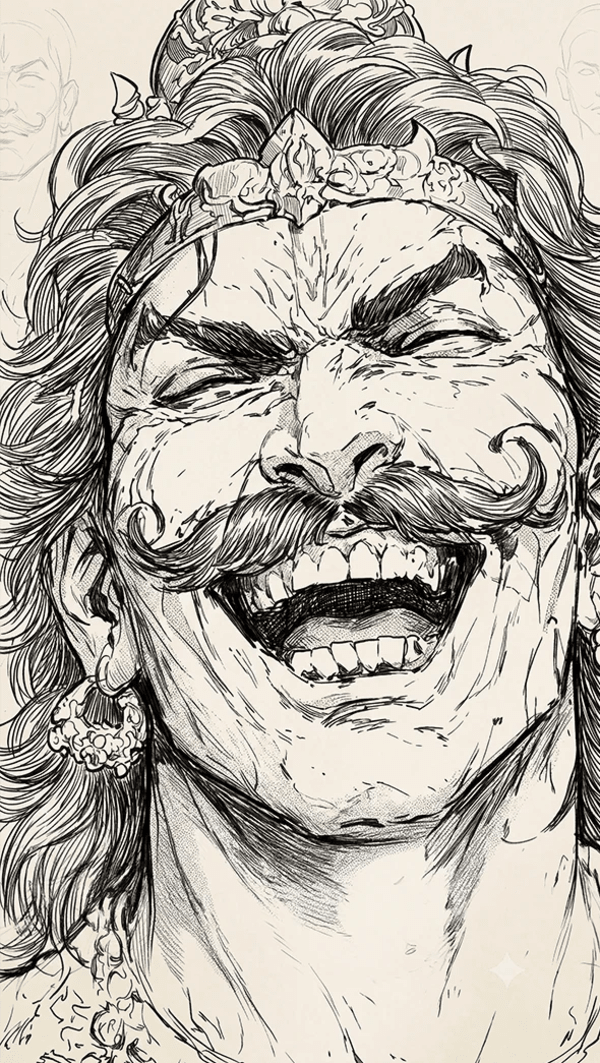
He laughs like Ravana
He laughs like Ravana.
His laughter is like that of the rakshasas.
I've heard this phrase assigned to me many times, most recently at the gym where I work out. It got me thinking. How do we actually know how those men laughed?
Were there jokes in those worlds the way we have jokes today? Did people laugh at the same things? Or have we simply decided that a certain kind of laughter belongs to evil?
Did Yudhishthira never laugh? Did Rama? What did Krishna's laughter sound like? What about the women? Did Sita, Draupadi, Kunti ever laugh out loud, or only weep and endure? Oh yes, women rakshasis laughed, again evil.
Was it mischievous, ironic, compassionate? Or was it the laughter of someone who already understood the shape of fate?
The texts do mention laughter. Ravana laughs. Rakshasas laugh. But their laughter is usually loud, excessive, or threatening. It tells us how the author wants us to see them, not necessarily what they actually sounded like.
There was also a real classification of laughter. The Natyashastra describes six forms, from a slight smile to laughter that is almost uncontrollable. It distinguishes between laughter that is appropriate, laughter that mocks, and laughter that turns vulgar.
I suspect the epics were shaped to carry duty, war, exile, betrayal and consequence, and that jokes, awkward silences and ridiculous moments simply weren't considered important enough to preserve alongside all that weight.
Or perhaps they survived elsewhere. In local retellings, in theatre, in oral performance. Yakshagana, for instance, brings in a jester at certain points, someone who cuts through the seriousness for a moment before the main story resumes. That comic thread exists, but as a force fit, not in the versions most of us grew up reading or watching.
We tend to imagine these characters as if they always stood inside the frame of their story, carrying the full weight of their roles. Rama being Rama. Krishna being Krishna. Ravana being Ravana.
But surely they also got bored. Made jokes. Laughed at the wrong moment. Irritated each other. Behaved foolishly.
Maybe the laughter we call Ravana like isn't evil at all. Maybe we've just never been given another way to read it.
Maybe it is only laughter that is too loud, too free, or too unconcerned with what the room expects.
Does your laughter match the room you're in?